By Ijeoma Okoro, DNP, APRN, FNP-BC · Founder, Better with IJ Wellness Clinic
There's a phrase you'll see on almost every spa menu, skincare label, and Instagram ad these days: medical-grade. It sounds reassuring. It also, in a lot of places, means very little.
I spent years in emergency medicine before I built a women's health and aesthetics practice, and that background shaped how I think about this work. In the ER, "medical-grade" isn't a marketing adjective. It means a licensed clinician assessed you, understood your history, chose an intervention with evidence behind it, and stayed accountable for the outcome. That's the standard I brought to aesthetics, and it's the standard I want you to expect anywhere you go for your face or your body.
So let's talk about what medical-grade aesthetics really is, what services fall under it, and how to tell the difference between clinical care and a facial with a clipboard.
The products and devices matter, but they're the easy part. Any business can buy a microneedling pen. What separates a medical aesthetics practice from a spa comes down to three things:
Here's how I explain the foundation of a medical aesthetics menu to patients. This isn't every service that exists, but these are the ones that earn their place through evidence and consistent results.
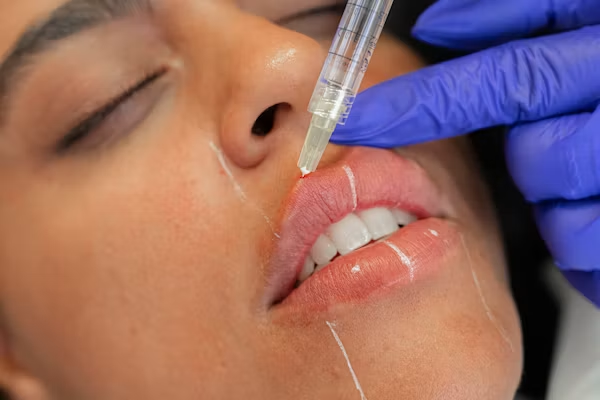
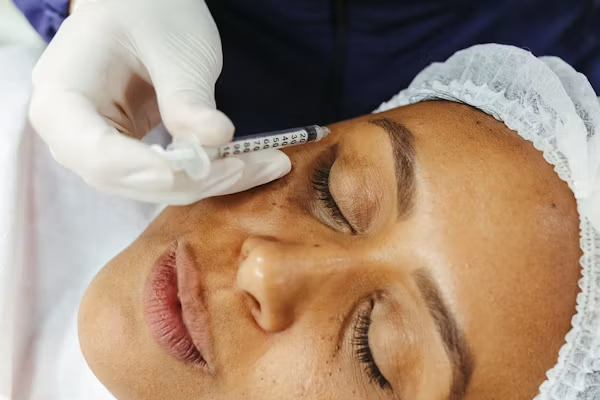
The most requested aesthetic treatment in the world, and still the most misunderstood. Neurotoxins temporarily relax the muscles that create dynamic wrinkles: forehead lines, the "11s" between the brows, crow's feet. Results appear over one to two weeks and last roughly three to four months.
What makes it medical-grade: a provider who maps your facial zones before injecting, adjusts for your muscle strength and expression patterns, and understands that the goal is a rested version of you, not a frozen one. It is also used clinically for jaw clenching, tension headaches, and excessive sweating, which is a good reminder that this is medicine first.
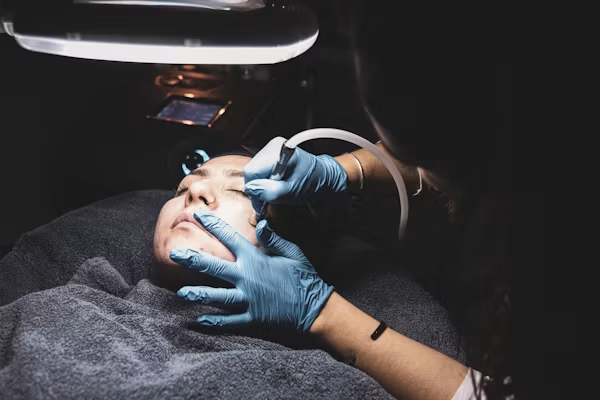
A device creates thousands of controlled micro-injuries in the skin, triggering your body's own collagen and elastin production. It's one of the most versatile treatments we offer: fine lines, acne scarring, enlarged pores, uneven texture, and overall firmness all respond well.
For melanin-rich skin, microneedling is often my first recommendation over lasers or aggressive peels because it improves texture and tone without relying on heat or pigment-targeting energy. That said, needle depth and pre- and post-care protocols matter enormously. Done correctly, it's one of the safest collagen-building treatments for deeper skin tones. Done carelessly, it can cause the very hyperpigmentation you came in to fix.
Late summer and early fall is the ideal window to start a series, once your sun exposure drops and your skin can focus on repair.
A sterile surgical blade gently removes the outermost layer of dead skin cells and fine vellus hair ("peach fuzz"). Skin looks instantly brighter, makeup applies more smoothly, and skincare products penetrate more effectively. It's low-risk, no downtime, and pairs beautifully with other treatments as a prep step.
Mechanical exfoliation using fine crystals or a diamond-tipped wand to resurface the skin and stimulate cell turnover. It addresses dullness, mild sun damage, light scarring, and uneven tone. It's gentler than chemical peels and a good entry point for patients who are new to clinical skincare.
The treatments above work best when what you do at home supports them. Medical-grade topicals (prescription-strength retinoids, clinically dosed vitamin C, tyrosinase inhibitors for pigment, and daily broad-spectrum SPF) contain active ingredients at concentrations that require clinical oversight to use safely. A provider should build your regimen around your treatment plan, not hand you a generic bundle.
Not strictly a skin treatment, but it belongs in a conversation about medical-grade wellness because it is medical: a licensed clinician places an intravenous line and administers vitamins, minerals, and hydration directly into the bloodstream. Patients use it for energy, recovery, hydration, and immune support. The clinical part is the screening: not everyone is a candidate, and dosing should be individualized.
This is the part most aesthetics-only businesses can't offer, and it's why I built Better with IJ health practice and my ideal client is a woman who values the intersection between health and wellness.
Your skin is an organ. It reflects your hormones, your metabolism, your sleep, and your stress. A woman in perimenopause who is losing collagen faster than she was five years ago may need hormone optimization alongside microneedling to see lasting results. A patient on a GLP-1 medication for weight management may experience facial volume loss that changes her aesthetic plan entirely. A patient with PCOS may be fighting acne and hyperpigmentation that no amount of topical treatment will fully resolve until the underlying condition is addressed.
Medical-grade aesthetics, at its best, sees the whole woman. That's what I mean by Self-Care as ScienceTM. It isn't indulgence. It's taking your body seriously enough to treat it with evidence.
Before you book anywhere, ask:
I structure my practice around three ideas. Educate: you deserve to understand what's being done to your body and why. Value: the standard of care for women, and for women of color especially, should be higher than it has historically been. Embody: the goal isn't to look like someone else. It's to look and feel like the most rested, confident, well-cared-for version of yourself.
Medical-grade aesthetics, done right, is simply good medicine applied to how you feel in your own skin. You should never have to choose between beautiful results and being treated like a patient.
If you're ready to start with a real consultation, we'd be honored to see you.
Ijeoma "Ij" Okoro, DNP, APRN, FNP-BC, is the Founder and Clinical Director of Better with IJ Wellness Clinic, a health and aesthetics practice serving patients across the Southwest and via telehealth. Follow along at @betterwithij.
This article is for educational purposes and does not replace an individualized medical consultation.
© 2026 All Rights Reserved.